
RESEARCH STUDY: How to make sweets healthy?
Rethinking Sweet Foods: A Low Glycemic Cookie Without Sacrificing Taste
What if you could enjoy a great-tasting chocolate chip cookie that delivers the same satisfaction as a traditional recipe, but with a significantly lower impact on blood sugar?
At AntiApp Technologies, that question led to the development of a model cookie that challenges long-held assumptions about sugar, and metabolic health. The result is a scientifically validated product that proves a powerful point: improving metabolic outcomes is not about removing sugar, but about how that sugar is in the food matrix !
A New Approach to Sweet Goods
Most approaches to “healthier” cookies focus on reducing or replacing sugar. Unfortunately, that often comes at the expense of taste, texture, and overall enjoyment. Sugar in right amount can be part of Healthy food … That may be contrarian but our formulation and subsequent clinical testing confirms our view.
This Svenka cookie is formulated with a complete complement of sugar, similar to a traditional chocolate chip cookie, to ensure optimal flavor. At the same time, it is engineered with a carefully designed ingredient matrix that delivers a low glycemic response.
It is not just the sugar in the food that matters. It is how the sugar is incorporated into the food matrix.
The Role of Dietary Fiber
One of the defining features of this cookie is its significantly higher dietary fiber content compared to standard cookies, while preserving the Taste!
Independent lab analysis confirmed that the high-fiber version contains approximately 13.4% total dietary fiber, far exceeding conventional formulations .
(The lab data also includes standard cookie analyses to compare with Svenka cookie composition)
This fiber is not added randomly. It is carefully selected and balanced to:
Slow carbohydrate absorption
Support a lower glycemic response
Maintain desirable taste and texture
The result is a cookie that behaves very differently in the body while still delivering the familiar experience consumers expect.
Clinically Proven Low Glycemic Response
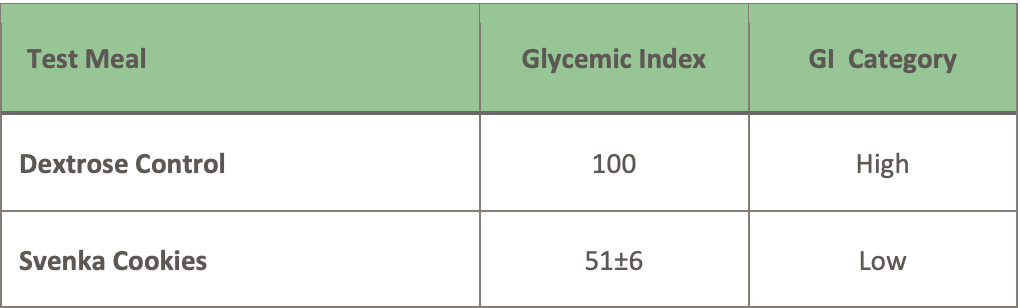
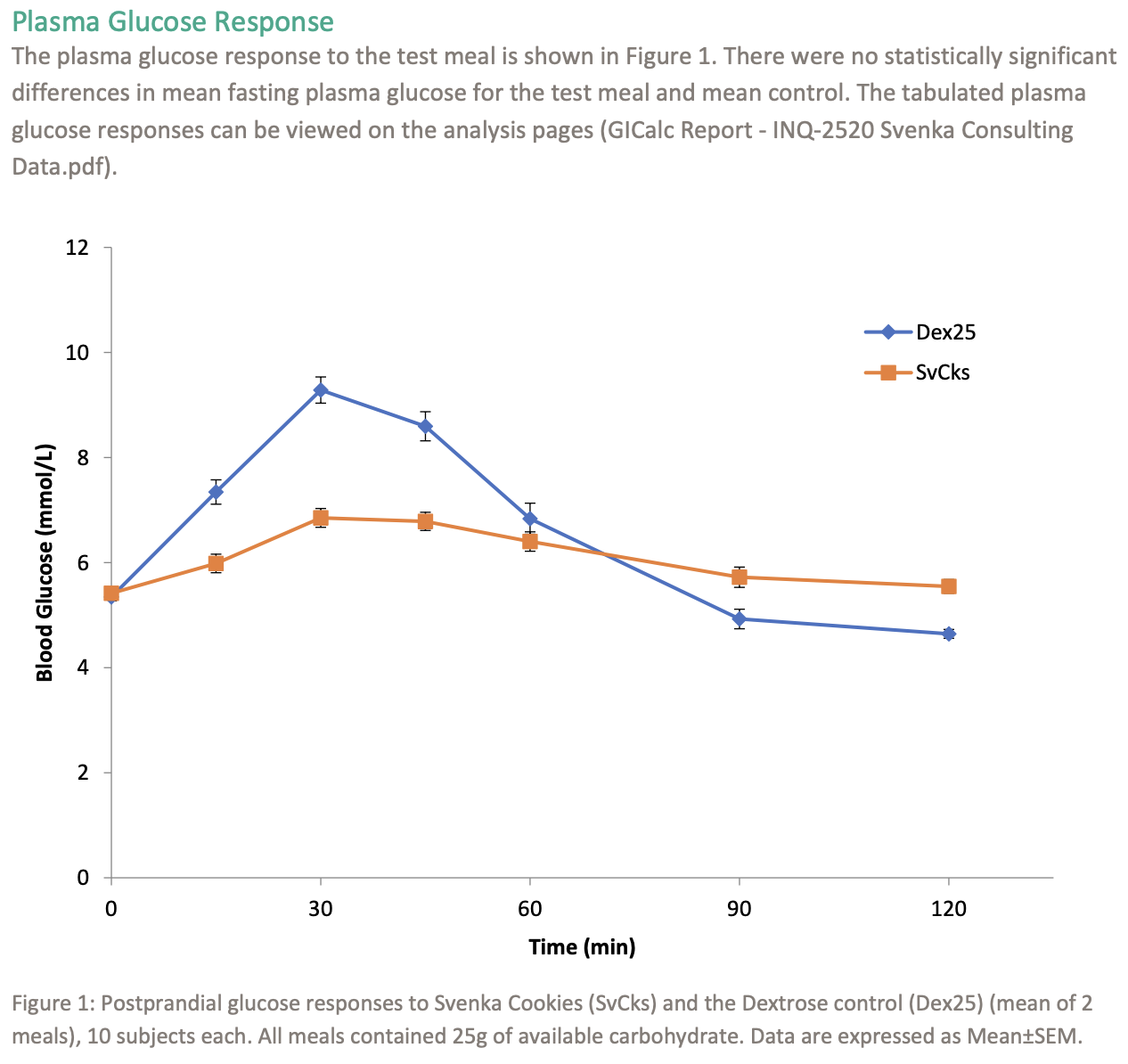
To validate the metabolic impact, the cookie was tested by Inquis Clinical Research in Toronto, Canada, using internationally recognized ISO standards.
The results were clear:
Glycemic Index (GI): 51 ± 6
Classified as a low glycemic food
This is a critical finding. Despite containing sugar, the cookie produces a controlled blood glucose response. This reinforces the central concept behind AntiApp’s approach: food structure and composition matter more than simply adding/removing ingredients.
Taste Still Matters
A functional product only works if people actually enjoy eating it.
To evaluate this, the cookie underwent sensory testing at the University of Nebraska–Lincoln Food Processing Center.
Panelists rated the cookie on a 9-point scale across key attributes:
Appearance: 7
Taste: 7.4
Texture: 5.75
Flavor: 7
Overall Acceptability: 7
These scores indicate that the cookie was liked moderately or better across most categories, including taste and overall appeal.
Some panelists noted slight differences in texture, which is expected in high-fiber formulations. We believe that one could further refine the texture with minor modifications. Yet, the overall acceptability was acceptable to the panelists.
Built on a Familiar Foundation
The formulation itself is modeled after a publicly available Nestlé chocolate chip cookie recipe, ensuring a recognizable baseline for taste and structure.
From there, it is enhanced with functional ingredients such as:
Speciality grain
Psyllium husk
Konjac fiber
All ingredients used in the formula are completely natural, reinforcing the product’s clean-label positioning.
Developed Through Scientific Collaboration
This work was carried out through a structured development process:
Product development and sensory work conducted by the University of Nebraska–Lincoln Food Processing Center
Analytical composition testing completed by Midwest Laboratories in Omaha
Glycemic index validation performed by Inquis Clinical Research in Toronto
All development was completed under a fee-for-service model through Svenka Consulting, now part of AntiApp Technologies, with full ownership of the resulting intellectual property.
What This Means for the Future of Food
This model cookie represents more than a single product. It serves as a proof of concept for an entirely new way of thinking about sweet goods.
It shows that:
Sugar does not need to be eliminated to improve metabolic health
Dietary fiber and food structure can significantly influence glycemic response
It is possible to balance taste, nutrition, and functionality in a single product
A Better Path Forward
For years, consumers have been forced to choose between foods that taste good and foods that support their health goals.
This research demonstrates that the tradeoff is not necessary.
By focusing on how foods are formulated, rather than simply what is removed, AntiApp Technologies is working to create solutions that support long-term metabolic health without compromising the eating experience.
Sources: